
Some of the best client projects start with a coffee, a trade show booth, and a conversation that goes "actually, we have exactly this problem."
That's how the Ponc.design story started.
It was October 2024, at the ArchExpo trade show in Dublin. I was wandering between stands with no particular agenda. Just curious to see what people were building, and open to a conversation. I stopped at a booth showing some beautiful wooden shelving units, and started chatting with Brian, the founder of Bear Creation.
Within ten minutes, we'd both realised the same thing: we were about to solve a problem that had been quietly costing them time, energy, and probably a fair number of sales.
Here's what happened next.
Brian and Knut Klimmek (managing director of Klimmek Furniture) had teamed up to design Ponc, a high-end modular wooden shelving system. Beautiful product, clever design. About 30 puzzle-like wooden pieces that can be combined into all kinds of shapes, sizes, and configurations. Customers can really make it their own.
Which sounds great. And it is great. Until you try to sell it.
Here's how the sales process used to work:
A customer would express interest. Great. Then the back-and-forth would begin.
What size are you thinking? What configuration? What wood finish? Do you have measurements of your space? Send us a photo. We'll mock something up in CAD and send it back. The customer would look at the CAD drawing, want a change. New CAD. New review. Another tweak. Another version. Then a small adjustment. Then... maybe one more thing.

By the time everyone agreed on the final design, weeks had passed. Sometimes months. Both sides exhausted. The product was always beautiful in the end, but the process was painful.
Brian put it best when he described it: "It was a never-ending ping-pong match."
And here's the thing: this isn't a Ponc problem. It's a bespoke product problem.
If your customer can choose colours, sizes, materials, or any combination of options, you're probably familiar with some version of this. Maybe it's not CAD drawings, maybe it's swatches or specs or mockups, but the pattern is the same: the customer wants to see it before they commit, and you spend hours showing them.
The traditional solutions don't really solve it. Photos can't show every variant. Sample boards help, but they can't show what the actual product will look like assembled. CAD drawings work, but they require you (or someone in your team) to make them, which is what creates the bottleneck in the first place.
What if the customer could design it themselves? Not in a complex CAD tool, but in something simple, intuitive, where they could try options, see the result in real time, and confirm what they want without anyone needing to send them another email.
This was roughly what we were talking about at Brian's booth when Knut joined us a few minutes later.
I'd been showing them some of our 3D viewers on my tablet, just to give them a sense of what interactive 3D looks like in practice. They were impressed, but more importantly, they were thinking.
"What if customers could not just see the product, but build it themselves?" one of them said. "Pick the modules, see them snap together, see the price update as they go?"
We all looked at each other for a second. Yes. That's exactly what we should build.
The next few weeks involved a proper proposal, technical scoping, and a lot of detailed conversation about exactly which options needed to be available, how the pricing logic should work, what the constraints were. (You can't combine every piece with every other piece. The system has rules.)
A few months later, the configurator was live.
The configurator is a 3D tool that lives on the Ponc website. A customer lands on it, and instead of being faced with a form or a contact request, they can start designing immediately. Drag a module. Add another. Change the wood finish. Adjust the height. Rotate the whole thing to see how it looks from a different angle.
And while they're doing all this, the price updates in real time. They know exactly what they're paying as they go. No surprises. No "I'll send you a quote next week."
When they're happy with the design, they can order it directly. No email thread. No CAD drawings. No waiting.
Here's what it looks like:

Try it yourself. Build a shelf. Change the modules. Watch the price respond. The whole thing took maybe a minute to learn, right?
That's the point. Brian's own words about what he wanted: "Something that didn't feel like flying a spaceship. Something simple, intuitive, where anyone could just jump in and design their own version."
And the visuals had to be good. Really good. Because customers are buying premium furniture, they need to see exactly what they're getting. Not a cartoon approximation, but something that looks like the actual product.
That's the harder part, technically. A configurator can be made simple by stripping down the visuals. Or it can look beautiful but be a nightmare to use. Doing both at the same time is what takes the work.
The most visible change was time. No more long email chains. No more redoing CAD drawings. The customer designs what they want, sees the price, and orders. The process that used to take weeks now takes minutes.
But there's a less obvious change that matters just as much: the customer experience is fundamentally different.
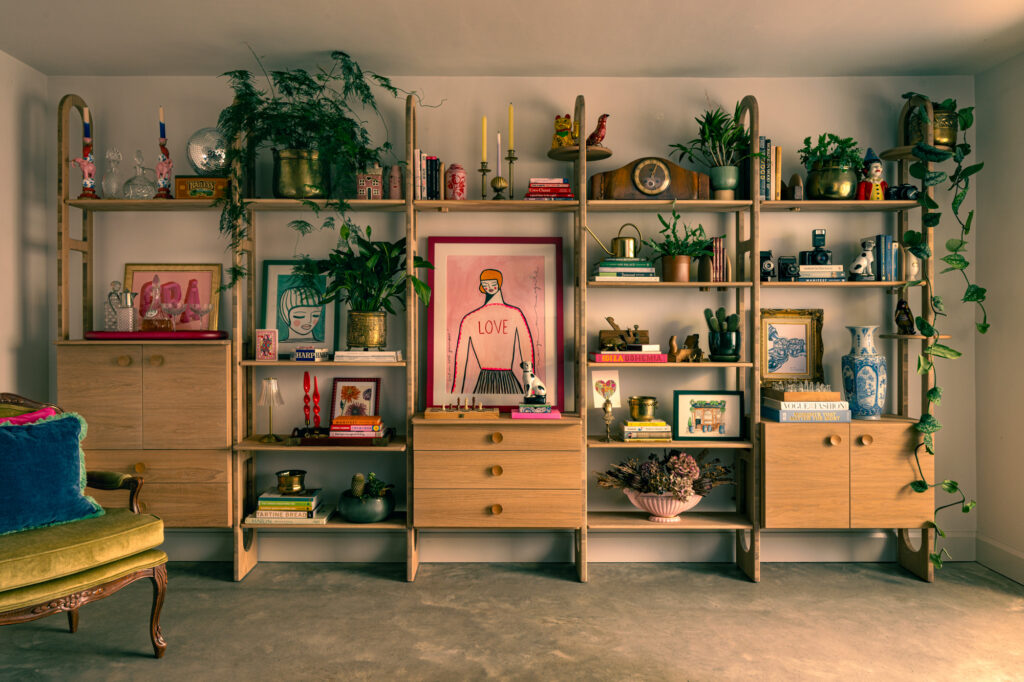
When you let a customer design their own product, something psychological shifts. They're not buying a shelf anymore. They're buying THEIR shelf. The one they configured. The one with their wood choice, their modules, their dimensions. That sense of ownership starts forming before they even click "buy," which is exactly when you want it to start forming.
Knut put it well: "It's a great sales tool that saves us a ton of time, and lets customers see their own design in a very attractive 3D view."
Brian added: "The 3D visuals absolutely blow my mind. It way over exceeded our expectations in terms of user experience."
There's one more thing worth mentioning, because it speaks to how we work, not just what we built.
Since the configurator launched, we haven't stopped working on it. As our 3D engine has evolved, we've added new features like improved shadows. When Knut and Brian came back to us in early 2026 with new products to add, including a folding desk, and new colour options they wanted to offer, we built them in. The configurator is alive, not frozen.
This matters because most software projects get delivered and then forgotten. Ours don't. The hosting fee that clients pay every month isn't just for keeping the lights on. It's for keeping the product current, the technology updated, and the door open for whatever comes next.
Pretty much any brand that sells customizable products has some version of this.
If your customers can choose between different sizes, colours, materials, finishes, or modular options, you're probably spending too much time on the back-and-forth. Maybe you have a sales team that handles it well, but that's a cost. Maybe you have a contact form and hope for the best, which loses you customers who don't want to wait. Maybe you have photos of every variation, which is expensive and still doesn't show what the customer's specific combination will look like.
A 3D configurator solves all of this at once. It puts the design power in the customer's hands, in a way that's actually enjoyable to use. They get exactly what they want. You get a clean handoff to production with no ambiguity. Everyone wins.
The interesting thing is that the customers seem to enjoy the process too. Configurators aren't a chore. They're closer to a game. You play with options, you see them come to life, and at the end you have something that feels personal. That's a much better experience than scrolling through a product gallery and trying to imagine what your version would look like.
And it's not just for furniture. Anything modular, customizable, or made-to-order is a candidate.
If your sales process involves a lot of back-and-forth before a customer can actually buy, there's probably a better way. We're happy to chat about whether a configurator makes sense for your product, what it would cost, and what it might look like.