
There is a moment I have learned to recognise on a sales call. The demo has gone well. They have turned the product, zoomed into the detail, said the word wow around the ten second mark. And then they go quiet.

It is almost never a loss of interest. They have just realised they have no idea what they would be agreeing to. How long does this take? What do I have to send you? Do I have to ship you my product? And nobody wants to ask a beginner's question in front of a supplier.
So here is the whole thing, start to finish. Six steps, no mystery, including the parts that are a bit of a nuisance.
Steps 1 and 2
The first step is us asking a lot of questions. What is the product, what do you want the display to do, and where will it live on your site.
That sounds like the soft part. It is the most important part, because a display that turns and zooms is a different build from one that animates, offers variants, or works as a configurator with rules about what combines with what.
I will be honest about why we are so fussy here. Changing the specification later is expensive, and sometimes means going back further than anyone would like. That is not a tactic, it is how the work behaves. An hour of conversation now saves a fortnight later.
Then comes the quote, in two parts: a one-time fee for building the assets and putting them live on your site, then an ongoing fee for keeping everything running.
Before the numbers, something that happens in almost every first conversation. When we asked potential customers to guess our prices before we said anything, most guessed several thousand euros per product.
The real figure is usually between 250 and 500 euros per object, more if you want animation or a long list of extras. The hosting and maintenance fee starts at 99 euros a month, and that is per customer account rather than per object, so it does not multiply as you add products. It rises a little if your site carries heavy traffic.
I mention this early because I would rather you knew than quietly decided not to ask.
Step 3
The best case is that your product already exists as a design file, either a CAD file from your manufacturer or a 3D file from whoever designed it. That is the fastest route by a wide margin, and nothing physical has to move.
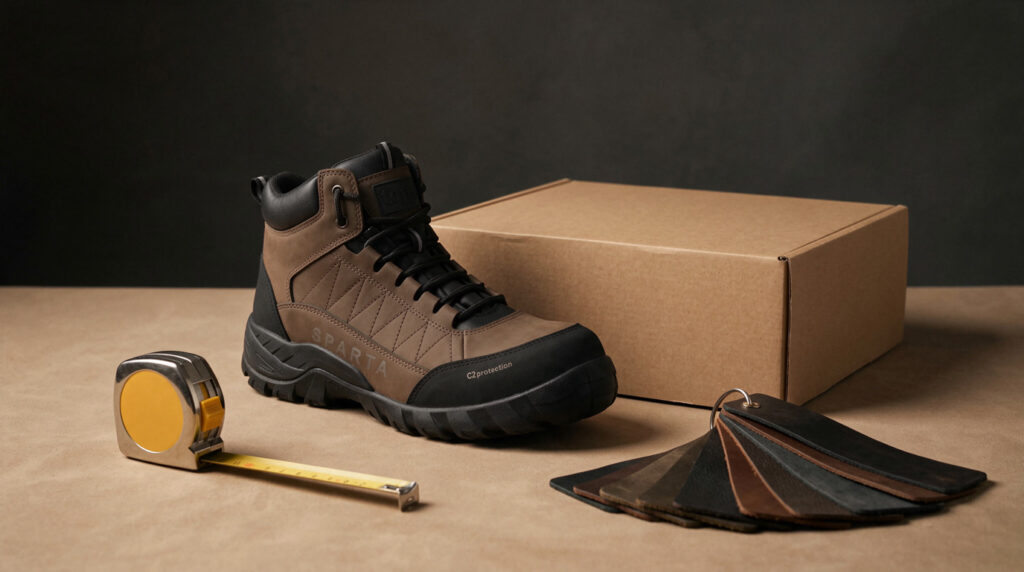
The far more common case is that you have nothing of the sort. That is completely normal. Furniture makers, craft producers and plenty of consumer goods brands have never had a design file in their lives, and it has never stopped a project. Hanza Working Gear are a good example. They make workwear and safety footwear, and when we started there was not a single design file to work from, so we scanned the shoes instead. You will meet one further down this page.
When there are no files, we scan the real thing, which brings us to the question everyone is too polite to ask. Yes, we usually need the physical product.
Most of the time it comes to us, and we would gently encourage that, because in our studio there is room to reshoot and no clock running. If it is too large to ship comfortably, or too precious to risk, we pack the equipment and come to you instead. That option exists for the one-off piece nobody wants to put in a van.
Occasionally scanning is not possible, and then we build the model by hand from photographs, drawings and measurements. It works, but it is rare, and we would rather scan.
Beyond that we need the boring but important things: your colour and material references, and the list of variants.
As for your own time, we genuinely need you at four moments. Agreeing the brief. Approving materials and colours. One round of feedback. Final sign-off. Between those, you can forget we exist.
Step 4
Our own website describes this step as our artists working their magic, which is a polite way of saying we did not want to bore you. But it is the interesting part, so let me open the box.
The product goes on a turntable and gets photographed from three to five hundred angles, more if it is complicated or has details needing special attention. Every point on the surface has to appear in several photographs, because the software works out the shape from the overlaps between images. That is the whole trick: enough viewpoints that nothing has to be guessed.
Our own rig adds something useful. It knows precisely where in space each photograph was taken, so every image arrives with its coordinates attached. The software never has to work out where the camera was, so reconstruction starts from fact rather than estimation.
What comes out is not usable yet. It is a cloud of millions of points floating in space, which then becomes a mesh of tiny triangles: accurate, and completely impractical. The next job is to rebuild it as a clean, efficient net holding the same silhouette with a fraction of the detail, rather like redrawing a scribble as clean line art.
Then come the materials, which is where leather starts looking like leather. This is less like painting a picture of a surface and more like describing how it behaves when light hits it, so it keeps behaving correctly from every angle.
And then optimisation, which decides whether any of this works. A model can look beautiful and still be so heavy it takes half a minute to appear, by which point your customer has been long gone. Our team spent years in video games, where the craft is making something look extraordinary on hardware you do not control. That is why our displays arrive in seconds rather than eventually.
Last comes quality control. We check the scale against the real measurements, the colours against the real product, and the behaviour on an old phone with a bad connection, because that customer will judge you hardest.
One honest word about colour. Screens are not print. There is no code that guarantees an identical result everywhere, so a finish that looks right on a calibrated monitor can look slightly different on yours, on your colleague's, and on your customer's. We get it as close as it can be got. Nobody can control what happens after that.
You then get a link to the finished result before anything goes near your website. This is one of those Hanza safety shoes, built exactly the way I have just described. It also does something a photograph cannot.
A safety shoe has a problem most products do not: everything worth paying for is hidden inside it. The protective layers in the sole, the reinforced toe. From the outside it looks like an ordinary shoe, which is the wrong impression entirely when the protection is the product.
So we made it come apart. Press the button in the viewer and the shoe separates into its layers. You could not photograph that without destroying a shoe.

Step 5
You get a link. Putting it on your product page is about as involved as embedding a video, and your web team will have done it before lunch.
But there is a real question underneath, and it deserves a real answer rather than a reassuring noise. Will it slow my site down?
The worry is legitimate. Research carried out for Google by Deloitte found that improving mobile load time by a tenth of a second lifted retail conversions by more than eight percent. Speed is not a technical detail, it is money.
Which is exactly why optimisation matters. A properly built 3D display weighs about the same as the high resolution photographs already on your page. The badly built ones, which gave 3D its slow reputation, can be thirty times heavier.
And for the very small number of visitors on a browser too old to show 3D, a still image appears instead. Nobody sees a broken box.
Step 6
We keep it running. When we improve the underlying technology, those improvements reach your display without anyone lifting a finger at your end. One client's configurator gained better shadows a year after launch because our rendering had improved. Nobody asked and nobody paid extra.
That is what the monthly fee covers, and it is worth repeating that it is charged per account rather than per object. One product with us or ten, it is one fee.
A 3D display is not a photograph or an asset you file away. It is working software sitting on your product page, and software nobody maintains ages badly. That is the difference between a supplier who hands over a file and one who keeps the thing alive.
Your questions
On timing: a straightforward product where you already have design files can be done in days. Something more complex, or something we have to scan from scratch, is more realistically a couple of weeks. A configurator is a different animal altogether and should be planned in months rather than weeks, because you are commissioning a small piece of software rather than a single asset.
Here is the honest bit though. The biggest cause of delay is almost never the modelling. It is waiting for feedback. A project can sit still for three weeks because a decision on a colour is waiting for someone who is on holiday.
On not liking it: you see the result and approve it before it goes anywhere public, and revisions are part of the process rather than an awkward conversation. The one thing that helps is gathering all your feedback in one go rather than sending it in a trickle over a fortnight. One clear list beats fifteen emails, for both of us.
If you have read this far, you understand the process better than most people do when they place an order.
None of it is complicated from your side. You tell us what you want, you send whatever you have, you approve the result, and you paste a link onto your product page. The difficult parts are our problem, which is rather the point of paying someone else.
If you are curious what your own product would involve, we are happy to walk through it and tell you honestly whether it is worth doing.