
A client asked me recently what it would cost to photograph two new fabric options. Not a new product. The same chair, in two new fabrics.
The honest answer was uncomfortable. A sample of each, built and shipped to a studio. A photographer booked for the day. A set dressed. Eight angles per fabric, because that is what their product page needs. Retouching on every frame. Then the same images again, cropped square for one marketplace, portrait for another, and vertical for social.
Two fabrics, one chair, several weeks and a four figure invoice.
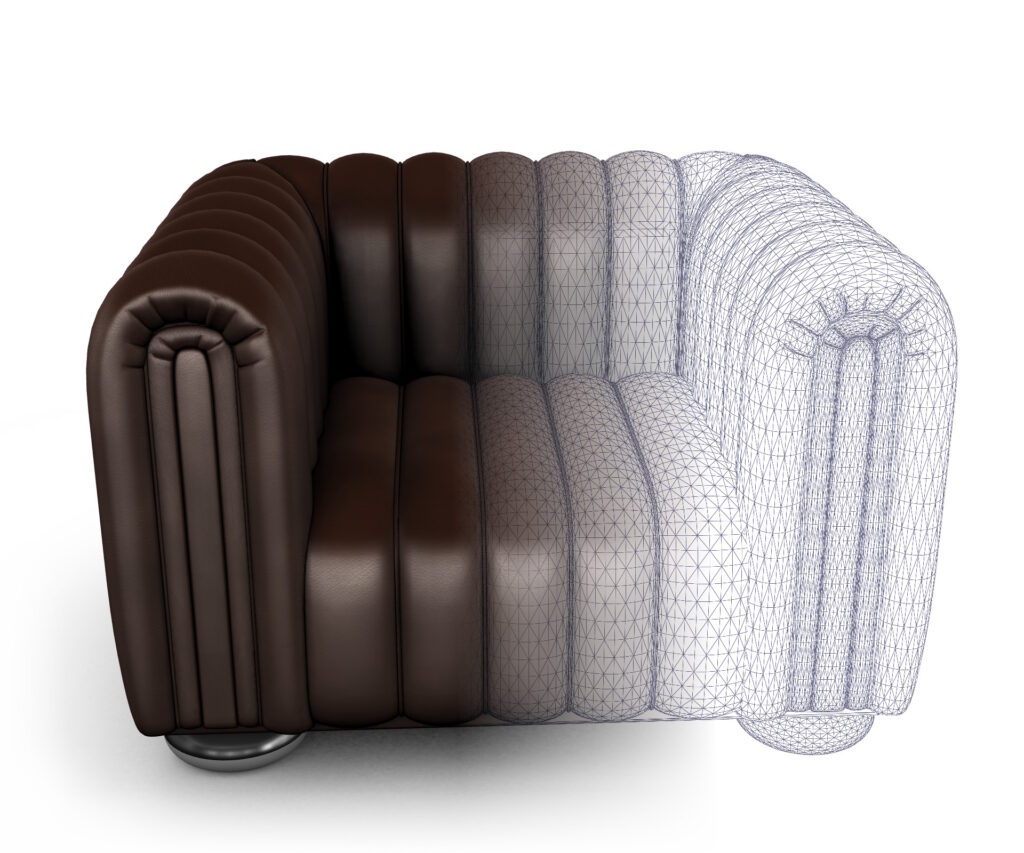
What made it worth writing about is that they already had a 3D model of that chair. It had been sitting on their product page for a year, quietly doing one job. It could have done all of the above in an afternoon.
That gap, between what a 3D model gets bought for and what it can actually produce, is the most expensive misunderstanding in product content right now.
And if you are reading this thinking you do not own a 3D model, so none of it applies to you, it is worth a check. If your product was designed on a computer, and most products now are, a 3D file of it already exists. It is usually sitting with whoever designed or manufactured it, doing nothing at all for your marketing.
Count how many images one of your products actually needs today. A simple item wants six to eight. Clothing wants eight to twelve. Furniture and anything technical wants ten to fifteen, and if you sell on a big marketplace, fifteen to twenty is closer to competitive.
Now multiply that by the number of places the product has to appear. Your own site. The marketplaces. Your retailers’ portals. Social. Email. Print. The screen in the showroom.
And every one of those places has its own rules. One marketplace insists on a pure white background with the product filling most of the frame. Another wants a perfect square under a strict file size. A third wants portrait. Social wants vertical. None of them accept each other’s crops.
This is not a problem that stays still. Adobe surveyed more than 1,600 marketers last year and found that 71 percent expect demand for content to grow more than fivefold by 2027. Budgets and team sizes, meanwhile, have mostly stayed where they were.
The costs that hurt are rarely the ones on the quote. It is the samples shipped back and forth, the retouching on every frame, the rush fee when a launch date moves, and the reshoot when the fabric supplier changes mid season. Industry guidance puts a reshoot at a quarter to a half of the original session cost. A brand with fifty products refreshing seasonally can comfortably spend the price of a small car every year on images of things it has already photographed.
The next time you scroll through IKEA’s website, it is worth knowing that most of what you are looking at never went near a camera.
IKEA build their product imagery from 3D models rather than photographs, and they have been doing it for a very long time, well before anyone thought to call it a content strategy. The furniture in those room sets is often assembled inside a computer, lit inside a computer, and photographed by a camera that does not exist.
The interesting part is not the technology. It is the order of operations.
In the traditional pipeline, the product comes first, the photograph comes second, and everything else in your marketing is cut, cropped and retouched from that photograph. The photo is the master asset. Every new requirement sends you back to the studio.
In the new pipeline, the model comes first. It is the master asset. The photograph becomes an output, one of many, produced on demand from something you already own. Nothing goes back to the studio, because the studio is inside the file.
You do not need IKEA’s budget to work this way. You need one accurate model of your product.
Here is what a single, properly built 3D model of your product can produce, without the product ever leaving your warehouse again:
That list is not evenly weighted, and it is worth being straight about which end we are built for. The last three are rendered images and video. We produce them, they are useful, and plenty of studios produce them too.
The rest is a different craft. Making a product look photographic in a still render is one problem. Making it look photographic while it turns, configures and responds instantly on a phone over mobile data is a much harder one, and it is the problem our team spent years solving in video games, where the entire discipline is beauty that runs in real time on whatever hardware the player happens to own. That is the end of the list our expertise sits at.
The exploded views deserve a moment too. There are shots you simply cannot take. The inside of a mechanism. A cutaway. A product floating in mid air with every component separated and labelled. With a model, those are not a special production. They are just another camera position.
Before you scroll past this, try something. Switch the colour, change the background, get in close on the armrest. Then work out how many separate studio setups you have just replaced, without anyone dressing a set or shipping a chair anywhere.

Every one of those variations, if you were shooting it, would be a separate setup. Here it is a click.
Let me be straight, because the honest answer comes with a condition attached.
If all you need is a couple of pictures of a product, once, and you will never need anything else, photography wins. It is quick, it is cheap, and there is no argument to make.
Past that point, the shape of the cost changes rather than the size of it. With photography you pay for the whole setup every single time: the sample, the studio, the lighting, the person behind the camera. With a model you pay to build it once. And I should be honest about something the 3D world tends to skip over: if we are scanning a physical product rather than working from your design files, that product has to reach us, or we have to come to it. That is a genuine cost and a genuine bit of hassle. The difference is that it happens once, not every time something changes.
But counting images against each other is the wrong way to think about this, and it is how our industry usually sells it. It assumes you are buying the same thing in two formats, and you are not.
A photograph is a picture of your product. A model is your product, in a form your customer can use. One of them can be cropped, printed and posted. The other can be turned, opened, animated, configured and stood on someone’s living room floor. There is no number of photographs that adds up to that, at any budget.
Ponc is the clearest example I have. We built them a configurator for a modular shelving system made of around thirty interlocking wooden components. It was never meant to replace their photography, and it did not. It exists so their customers can design their own shelving unit and watch it take shape as they go, which is not something a photograph could have done for them however many they had commissioned.
What matters here is what happened next. Earlier this year the founders came back wanting new colour options and a new product in the range, a folding desk. The colours went in as materials. The desk was modelled once and added to the system. Everything already built carried on working, and nothing had to be produced again from scratch. That is the part that keeps giving.
I am not going to tell you that 3D replaces photography, because it does not, and anyone who tells you otherwise has something to sell you.
Real people belong in photographs. A model wearing your coat, in real light, on a real street, with a real expression: that is a photograph, it should stay a photograph, and no render is going to carry the same feeling. The same goes for your campaign hero shots, where the whole point is a photographer’s eye and a moment that could not be planned. Food is its own art form. And there are products, very small or very intricate ones, where the modelling cost outweighs what you get back.
Artificial intelligence belongs in this conversation too, and we use it ourselves. It is very good at inventing a setting: a room, a street, a mood. What it is not good at is your product, because it will happily invent that as well, and invented detail on something a customer is about to order is a returns problem waiting to happen. So we keep the accurate model as the fixed anchor and let AI build the world around it, with a person checking the result before it goes anywhere.
Most brands that get this right end up doing both. 3D handles the catalogue, the variants, the marketplaces and the interactive experience. Photography handles the stories with people in them.
If you already have a 3D model of one of your products, have a look at what you are using it for. If the answer is that it spins on a product page and nothing else, you are getting perhaps a tenth of what you paid for.
And if you do not have one yet, the question is not really whether 3D is worth it for a single product page. It is what the whole year of images, variants, campaigns and channel formats is costing you at the moment, and how much of that a single well built model could absorb.
We are always happy to look at that with you and be honest about where the line falls for your products.